Build a Recruiting System That Converts Applicants
Recruiting System, Applicant Conversion, Talent Acquisition, Effective Recruitment
How to Build a Recruiting System That Actually Converts Applicants Into Hires
Most agencies and growing businesses don’t have a recruiting problem—they have a recruiting system problem. They get applicants, but very few convert into qualified interviews and consistent hires. In this guide, you’ll learn how to design a performance-driven recruiting engine that turns job applicants into predictable placements, using data, automation, and proven job applicant strategies.
Why Your Current Recruiting System Isn’t Converting
If you rely on job boards, manual follow-up, and scattered spreadsheets, you don’t have a true recruiting system—you have a collection of activities. That’s why:
Great candidates leak out of your pipeline because no one follows up fast enough.
Hiring managers complain about “low quality” even when applications are high.
You can’t answer basic questions like conversion rate from applicant to interview or time-to-fill by role.
A modern talent acquisition operation treats recruiting like a revenue pipeline: measurable, automated, and optimized. That’s exactly what Recruiter Machine is built to support—and it starts with redefining what “system” actually means in the context of effective recruitment.
Step 1: Define a Clear, Measurable Hiring Process
Before you automate anything, you need a simple, standardized hiring process that every recruiter and hiring manager follows. Think in terms of stages, not chaos. A high-converting recruiting system usually includes at least these steps:
Attract: Job posting, sourcing, referrals, outbound outreach.
Screen: Application review, knockout questions, basic qualification.
Engage: Automated follow-up, scheduling, pre-interview nurturing.
Evaluate: Structured interviews, assessments, hiring manager feedback.
Decide & Close: Offer, negotiation, pre-boarding.
Each stage must be clearly defined, with ownership, timelines, and criteria. When Recruiter Machine onboards a new client, this is the first thing we map: what exactly needs to happen for an applicant to move from “applied” to “hired”?
📌 Key Takeaway: You can’t improve applicant conversion if you don’t know which stage they’re dropping out of. Define stages first; optimize second.
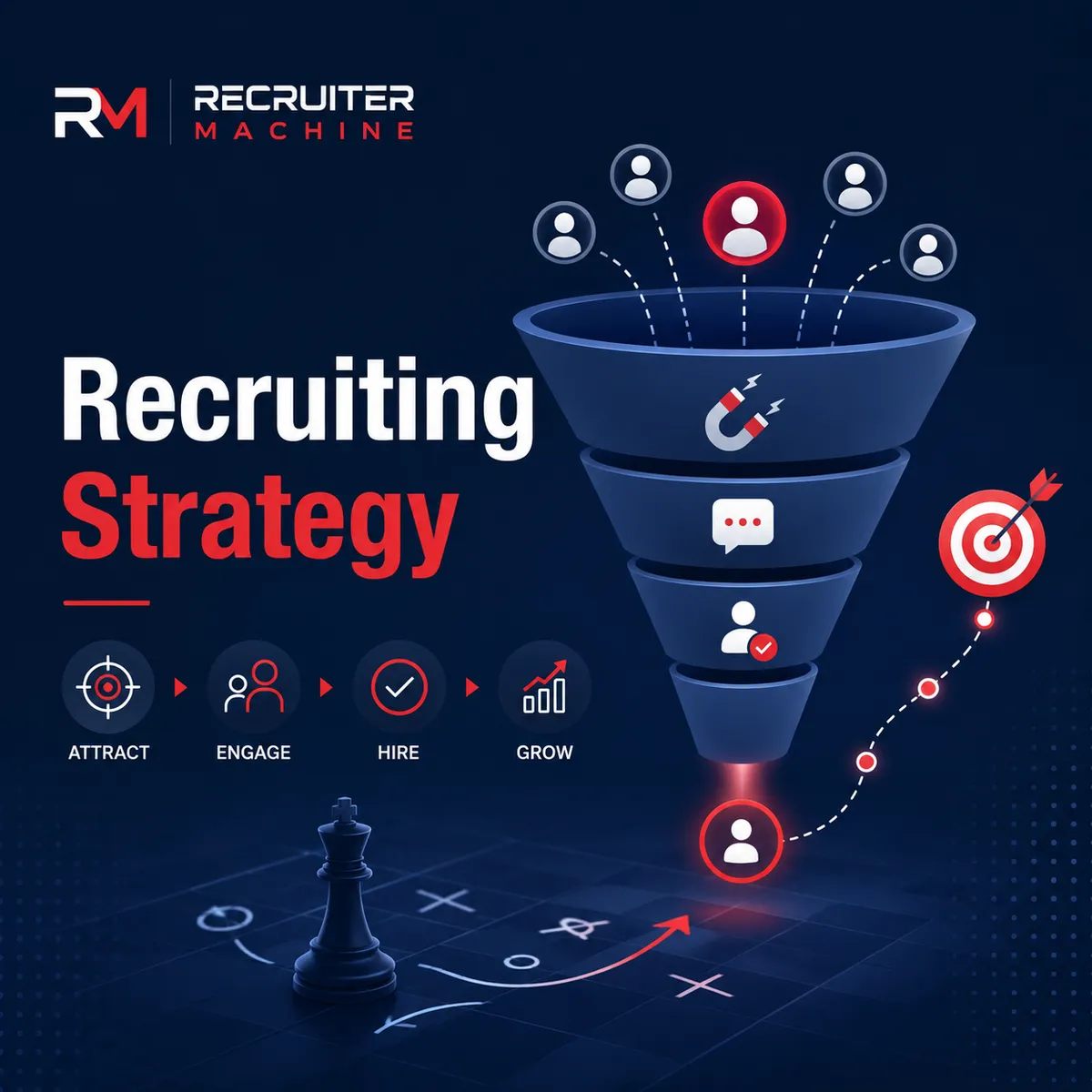
Step 2: Design Your Ideal Applicant Conversion Funnel
A recruiting system that converts behaves like a sales funnel. You attract leads (candidates), qualify them, nurture them, and close them. To build that funnel intentionally, set target conversion rates for each step. For example:
100 applicants → 40 phone screens (40% conversion)
40 phone screens → 15 hiring manager interviews (37.5% conversion)
15 interviews → 4 offers (26.7% conversion)
4 offers → 3 hires (75% conversion)
These numbers are just examples, but they give you a benchmark. When you track this inside a platform like Recruiter Machine, you can see exactly where applicant conversion breaks down and which roles or recruiters need support.

High-performing teams track conversion at every stage to tune their hiring process.
Step 3: Upgrade Your Job Applicant Strategies at the Top of the Funnel
You can’t convert what you don’t attract. But more volume alone doesn’t fix a weak hiring process. You need better inputs—higher quality applicants and more relevant talent. Focus on three core job applicant strategies at the top of your talent acquisition funnel:
1. Role-Specific, Outcome-Focused Job Descriptions
Generic job ads attract generic candidates. High-converting recruiting systems use job descriptions that:
Lead with outcomes (“In 6 months, you will have…”) instead of only responsibilities.
Clarify non-negotiables versus “nice to have” skills to reduce misaligned applicants.
Explain the hiring steps and timelines so candidates know what to expect.
2. Multi-Channel Sourcing, Not Just Job Boards
Effective recruitment doesn’t depend on a single channel. Agencies and sales-driven organizations win when they combine:
Job boards and aggregators for scale.
LinkedIn and niche platforms for targeted outreach.
Referral campaigns and talent pools for warm candidates.
Recruiter Machine’s AI sourcing and automation help you turn these channels into a single, unified pipeline instead of disconnected streams you can’t measure.
3. Reduce Friction at Application
Long, clunky application forms kill applicant conversion before it begins. For most roles, you don’t need a 20-minute form to decide whether to schedule a screen. Instead:
Ask 3–5 knockout questions that directly map to success in the role.
Allow quick apply and then gather additional details later in the process.
Make the application mobile-friendly; many top performers apply from their phones.
💡 Pro Tip: Track “career page visits → applications started → applications completed.” A small lift here can dramatically improve your overall talent acquisition output.
Step 4: Automate Speed-to-Response and Follow-Up
The fastest recruiter usually wins the candidate. Yet many agencies still take days to acknowledge an application. That’s where automation turns into a competitive advantage and directly boosts applicant conversion.
Instant Acknowledgment and Pre-Qualification
As soon as someone applies, your recruiting system should:
Send a branded confirmation email or SMS that sets expectations and next steps.
Run automated screening based on your knockout questions and key criteria.
Route qualified candidates to a recruiter or directly to a scheduling link.
Recruiter Machine automates this flow so your team spends time talking to the right people instead of manually sorting through every resume.
Multi-Touch Nurture for Passive and Busy Candidates
Not every strong candidate replies to the first message. Effective recruitment treats candidates like prospects in a sales sequence:
Use 5–7 touchpoints across email, SMS, and LinkedIn over 7–10 days.
Share role highlights, team stories, and short video messages from hiring managers.
Make it easy to book a time directly from any message.
This is where a SaaS platform like Recruiter Machine shines—automated follow-up sequences ensure no interested applicant gets forgotten, lifting your overall applicant conversion without adding headcount.
Step 5: Make Evaluation Structured, Fast, and Candidate-Friendly
Many strong candidates drop out during interviews because the experience is slow, disorganized, or unclear. To convert more applicants into hires, tighten this part of your hiring process with structure and speed.
Use Scorecards Instead of Gut Feel
High-performing talent acquisition teams use role-based scorecards that define:
The 4–6 core competencies that matter most for success in the role.
Behavioral and situational questions mapped to each competency.
A 1–5 rating scale with clear definitions for each level.
This approach reduces bias, speeds up decision-making, and gives candidates a fairer experience—all of which support stronger applicant conversion and better long-term hires.
Compress Timelines and Communicate Clearly
Every extra day between interviews and offers increases the chance you’ll lose top talent. Build your recruiting system to:
Schedule all interviews within a tight 7–10 day window whenever possible.
Commit to response SLAs (for example, “you’ll hear from us within 48 hours”).
Automate updates so candidates aren’t left wondering where they stand.
📌 Key Takeaway: A fast, transparent interview experience is one of the most powerful job applicant strategies you can deploy to stand out in competitive markets.
Step 6: Close Candidates Like You Close Clients
Many recruiters treat the offer stage as a formality. In reality, it’s a sales conversation. Effective recruitment means selling the role, the manager, the culture, and the growth path with the same intensity you use to win new business.
Ask closing questions throughout the process (“How are you feeling about this role so far?”).
Surface and address objections early rather than waiting until the offer.
Share tailored information that speaks to each candidate’s priorities (growth, flexibility, compensation, impact).
A strong recruiting system also includes pre-boarding workflows: automated check-ins, paperwork reminders, and welcome content that keep your new hire engaged between acceptance and day one, reducing no-shows and last-minute drop-offs.
Step 7: Make Data and KPIs the Engine of Talent Acquisition
Without data, you’re guessing. Performance-driven talent acquisition teams run on metrics. At a minimum, track these KPIs inside your recruiting system:
Applicants per role and per source
Conversion rates between every stage (applicant → screen → interview → offer → hire)
Time-to-first-contact and total time-to-fill by role and recruiter
Offer acceptance rate and new hire retention at 90 days / 6 months
Recruiter Machine centralizes these metrics in one dashboard so independent recruiters, staffing agencies, and in-house teams can see exactly which job applicant strategies are working and where to double down.
Putting It All Together: Your High-Converting Recruiting System Blueprint
When you combine everything we’ve covered, you get a clear blueprint for a recruiting system that consistently converts applicants into hires:
Standardize the hiring process into clear, trackable stages from apply to hire.
Design your conversion funnel with target percentages between each stage.
Upgrade top-of-funnel strategies with better job ads, multi-channel sourcing, and low-friction applications.
Automate speed-to-response and multi-touch follow-up so no strong candidate slips away unnoticed.
Run structured, fast evaluations using scorecards, clear timelines, and candidate-friendly communication.
Close and pre-board like a sales pro, treating offers as high-value deals that require strategy and follow-through.
Run on data, not guesswork, by tracking KPIs and continuously optimizing for higher applicant conversion.
How Recruiter Machine Helps You Operationalize This System
Building this kind of system from scratch with disconnected tools is possible—but slow and painful. Recruiter Machine was built specifically for independent recruiters, agencies, staffing firms, and growth-focused businesses that want to:
Automate repetitive recruiting tasks without losing the human touch.
Centralize pipelines, follow-up, and hiring process workflows in one place.
Track every key recruiting KPI in real time, from source performance to applicant conversion.
Instead of stitching together spreadsheets, inboxes, and calendar links, you get an all-in-one recruiting system designed to be predictable, systematic, and scalable—exactly what performance-driven recruiting teams need to grow.
💡 Pro Tip: Treat your recruiting tech stack like a revenue stack. If it doesn’t improve speed, conversion, or visibility, it’s probably slowing you down.
Final Thoughts: Turn Recruiting Into a Predictable Growth Engine
Agencies and growing businesses don’t win by posting more jobs—they win by building effective recruitment systems that convert consistently. When you:
Clarify your hiring process,
Treat candidates like high-value prospects,
Automate the right touchpoints,
And run on data instead of guesswork,
you transform recruiting from a reactive scramble into a reliable engine that feeds your business with the talent it needs to grow. That’s the promise behind Recruiter Machine: a modern recruiting system that turns broken, manual processes into a predictable, automated, and measurable operation.
If you’re ready to see what this looks like inside your agency or business—and how much more you could be getting from the applicants you already attract—there’s a straightforward next step.
📌 Call to Action: Turn your recruiting into a predictable, scalable growth system. Book Your Recruiting Demo with Recruiter Machine and see how fast you can improve applicant conversion across every role you hire for.